South Sudan fighting displaces nearly 280,000; UN warns of ‘perfect storm’
UN Health
|
فبر 23, 2026
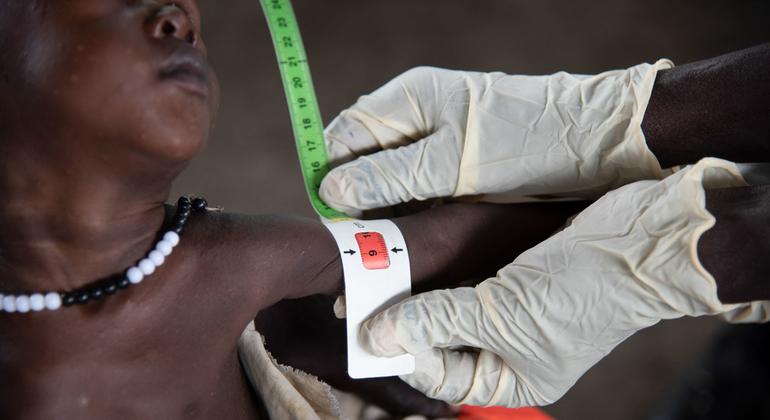
Renewed fighting in South Sudan’s Jonglei state has displaced hundreds of thousands of civilians in recent weeks, damaged health facilities, fuelled the spread of cholera and prompting the UN relief chief to warn of a “perfect storm” of conflict, climate shocks and deprivation.
© UNICEF/Helene Sandbu Ryeng
A nutrition worker measures the arm of a severely malnourished baby at a clinic in South Sudan. Fresh fighting in Jonglei state has displaced nearly 280,000 people. (file photo)
Facebook
Twitter
Print
Email
Renewed fighting in South Sudan’s Jonglei state has displaced hundreds of thousands of civilians in recent weeks, damaged health facilities, fuelled the spread of cholera and prompting the UN relief chief to warn of a “perfect storm” of conflict, climate shocks and deprivation.
The escalation comes amid rising protection risks for civilians and aid workers, with three humanitarian personnel killed between 7 and 16 February in Jonglei and Upper Nile states, according to the UN relief coordination office, OCHA.
Access to some of the worst-affected areas remains uneven despite renewed pledges by authorities to allow relief operations.
Last Friday, Emergency Relief Coordinator Tom Fletcher arrived in the country for a five-day mission to draw international attention to what he described as a deteriorating and underreported crisis.
“So here in South Sudan, you have this perfect storm of climate change and conflict and inequality and poverty,” Mr. Fletcher said upon arrival. “Right now, people here in South Sudan feel that no one is listening.”
© UNOCHA
Emergency Relief Coordinator Tom Fletcher (left) at the Akobo County Hospital in Jonglei state in South Sudan.
Displacement surgesClashes between the South Sudan People’s Defence Forces – the national army – and elements of the rival Sudan People’s Liberation Army-in-Opposition (SPLA-iO), which resumed in late December, have triggered large-scale displacement across central and northern Jonglei.
According to South Sudanese authorities, nearly 280,000 people have fled their homes across eight counties, with many moving into Upper Nile and Lakes states.
Families are sheltering in the open or in makeshift structures, with urgent needs for food, healthcare and basic supplies. Markets and agricultural activities have been disrupted, leaving several communities with little or no access to food.
The UN World Food Programme (WFP) has scaled up food assistance but fighting and insecurity – including looting of aid convoys – are hampering the response.
In Akobo, southern Jonglei state, Mr. Fletcher visited a local hospital, where at least 93 patients with gunshot wounds had been treated by 18 February.
“Civilians should never be a target,” he said, after meeting victims that included an 18-month-old child and a 70-year-old grandmother.
At the hospital, a humanitarian worker recounted: “The father was shot. The mother was abducted.” The grandmother had walked seven days for help. Asked whether she had received food, Mr.
This article was originally published by UN Health. For more details, images, and references:
Read Full Original Article ↗