Measles cases drop in 2025 across Europe and Central Asia, but outbreak risks remain
UN Health
|
二月 11, 2026
Measles cases across Europe and Central Asia declined by 75 per cent in 2025 compared to 2024, according to preliminary data released on Wednesday by the World Health Organization (WHO), which warned of remaining outbreak risks.
© UNICEF/Giacomo Pirozzi
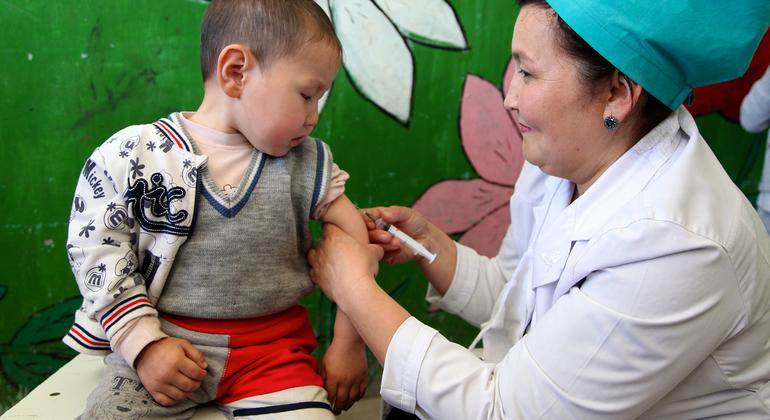
A young boy receives a measles immunization in Osh city in southwestern Kyrgyzstan.
Facebook
Twitter
Print
Email
Measles cases across Europe and Central Asia declined by 75 per cent in 2025 compared to 2024, according to preliminary data released on Wednesday by the World Health Organization (WHO), which warned of remaining outbreak risks.
“While cases have reduced, the conditions that led to the resurgence of this deadly disease in recent years remain and must be addressed,” said Regina De Dominicis, the UN Children Fund (UNICEF) regional director for Europe and Central Asia.
Fifty-three countries in Europe and Central Asia reported 33,998 measles cases in 2025, down from 127,412 in 2024.
The overall decreasing trend in cases reflects both outbreak response measures and the gradual decline in the number of people susceptible to measles infection as the virus made its way through under-vaccinated communities, according to UN agencies.
However, many cases could have been prevented with higher routine vaccination coverage at community level and more timely response to outbreaks, UN agencies said.
“Until all children are reached with vaccination, and hesitancy fuelled by the spread of misinformation is addressed, children will remain at risk of death or serious illness from measles and other vaccine-preventable diseases,” she warned.
Hans Henri P. Kluge, WHO regional director for Europe, said eliminating measles is essential for national and regional health security, stressing that “in today’s environment of rampant fake news, it’s also crucial that people rely on verified health information from reliable sources such as WHO, UNICEF and national health agencies.”
The number of cases in 2025 still exceeded what has been reported for most years since 2000, and some countries reported more cases in 2025 than in 2024. Measles cases continue to be detected in 2026 in the region, according to WHO.
“Over 200,000 people in our region fell ill with measles in the past three years,” Dr. Kluge said.
“Unless every community reaches 95 per cent vaccination coverage, closes immunity gaps across all ages, strengthens disease surveillance and ensures timely outbreak response, this highly contagious virus will keep spreading.”
Measles is one of the most contagious viruses affecting people. For every one person who has measles, up to 18 other unvaccinated people will be infected.
This makes measles around 12 times more contagious than influenza. As well as hospitalisation and death, the virus can cause long-term, debilitating health complications.
It can also damage the immune system by “erasing” its memory of how to fight infections for months to even years, leaving measles survivors vulnerable to other diseases and death.
This article was originally published by UN Health. For more details, images, and references:
Read Full Original Article ↗